
AEO vs SEO for Indian Businesses in 2026
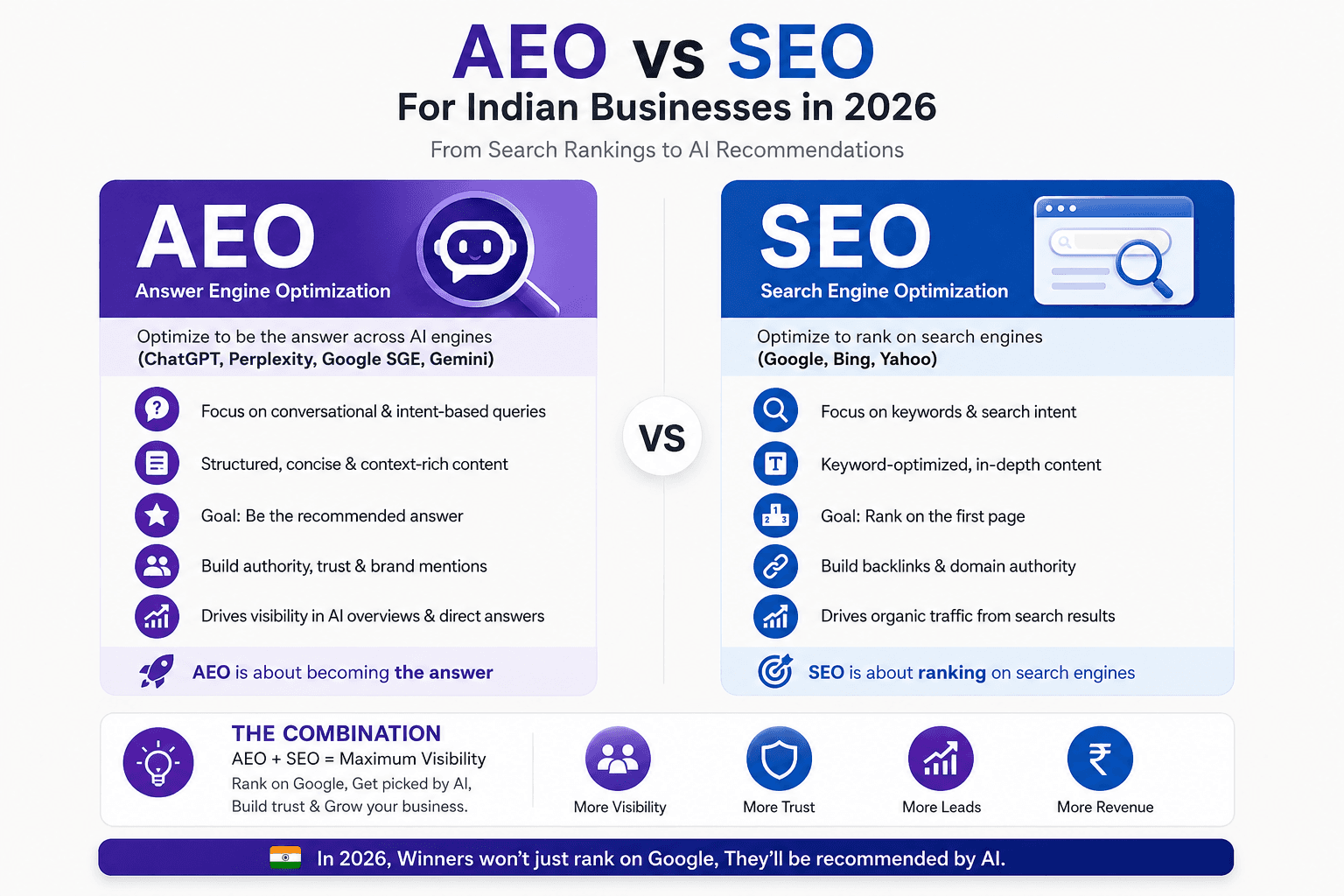
AEO vs SEO for Indian Businesses in 2026
For years, Indian businesses had one major digital visibility goal:
Rank on Google.
If your website appeared on page one, you won.
More traffic. More inquiries. More leads. More credibility. More sales.
SEO was the main game.
But in 2026, search has changed.
People are not only typing keywords into Google anymore.
They are asking AI tools.
They are asking ChatGPT. They are asking Perplexity. They are asking Gemini. They are asking Claude. They are asking Copilot.
And they are not searching like this:
"digital marketing agency Gurgaon"
They are asking:
"Which digital marketing agency in Gurgaon can help a consultant generate inbound leads?"
They are not searching only:
"best insurance advisor Delhi"
They are asking:
"Recommend a trusted insurance advisor in Delhi for term insurance and family protection planning."
They are not searching only:
"business coach India"
They are asking:
"Who is a good business coach in India for startup founders struggling with sales systems?"
This is a different type of search.
It is more conversational. It is more specific. It is more intent-driven. It expects a direct answer.
That is why businesses now need more than SEO.
They need AEO.
AEO stands for Answer Engine Optimization.
SEO helps your website rank in search engines.
AEO helps your brand become the answer in AI tools.
In 2026, Indian businesses that understand both will dominate visibility.
Businesses that ignore AEO may still have websites, blogs, and social media pages — but they may become invisible in the places where high-intent clients are now asking for recommendations.
This article explains the difference between SEO and AEO, why both matter, and how Indian businesses can build a digital presence that gets found by humans, search engines, and AI tools.
What is SEO?
SEO stands for Search Engine Optimization.
It is the process of improving your website so search engines like Google can understand, index, and rank your pages for relevant searches.
Traditional SEO focuses on things like:
- Keywords
- Website structure
- Page speed
- Mobile experience
- Backlinks
- Blog content
- Internal linking
- Meta titles
- Meta descriptions
- Technical SEO
- Local SEO
- Google Business Profile
- User experience
For example, if you are a real estate consultant in Gurgaon, SEO helps your website appear when people search:
- Real estate consultant in Gurgaon
- Property advisor Gurgaon
- Commercial property consultant Gurgaon
- Best real estate consultant near me
SEO is still important.
Very important.
People still use Google. Google still drives traffic. Search rankings still create leads. Local SEO still matters for service businesses.
But SEO alone is no longer enough.
Because the client journey is changing.
Earlier, people searched, clicked, and compared websites.
Now, they ask AI tools to summarize, recommend, and filter options before they even visit your website.
That is where AEO enters.
What is AEO?
AEO stands for Answer Engine Optimization.
It is the process of optimizing your digital presence so AI tools and answer engines can understand your expertise, trust your authority, and recommend you as a useful answer.
AEO is not only about ranking a page.
It is about becoming the recommended answer.
With AEO, your goal is to appear when someone asks:
- Who is the best consultant for this problem?
- Which agency can help with this outcome?
- What is the best solution for this situation?
- Who are trusted experts in this niche?
- Which company provides this service in my city?
- What should I consider before hiring this expert?
AEO focuses on signals like:
- Clear brand positioning
- Expert content
- Question-answer structure
- Author credibility
- Case studies
- Reviews and testimonials
- External mentions
- Entity consistency
- Structured data
- FAQs
- Topical authority
- Fresh content
- LinkedIn authority
- Website clarity
- Trust signals across multiple platforms
SEO helps search engines find your pages.
AEO helps AI tools understand your authority.
That is the key difference.
SEO vs AEO: The Simple Difference
Here is the simplest way to understand it:
SEO helps you rank.
AEO helps you get recommended.
SEO is about showing up in search results.
AEO is about being included in AI-generated answers.
SEO asks:
"How do we rank for this keyword?"
AEO asks:
"How do we become the trusted answer for this question?"
SEO targets keywords like:
"LinkedIn marketing agency India"
AEO targets questions like:
"Which agency in India can help consultants generate inbound leads from LinkedIn?"
SEO focuses on pages.
AEO focuses on entities.
SEO improves visibility.
AEO improves recommendation potential.
Both are important.
But they work differently.
Why Indian Businesses Cannot Ignore AEO in 2026
Indian customers are becoming more research-driven.
Before buying, they compare.
Before booking, they search.
Before trusting, they verify.
Before calling, they check your digital presence.
This is especially true for high-trust services like:
- Insurance advisory
- Business coaching
- Consulting
- Digital marketing
- Legal services
- Financial planning
- Real estate advisory
- Healthcare
- Education
- B2B services
- Personal branding
- Professional training
These are not impulse purchases.
People want guidance.
They want credibility.
They want proof.
They want confidence.
AI tools make this research easier.
Instead of opening 10 websites, a user can ask one AI tool:
"Compare the best digital marketing strategies for Indian coaches in 2026."
Or:
"Who can help a CA in Mumbai build a LinkedIn personal brand?"
Or:
"What should I look for before hiring an insurance advisor in India?"
If your brand has no clear AEO signals, AI may not mention you.
Even if you are good.
Even if your clients trust you.
Even if your service quality is strong.
Because AI cannot recommend what it does not clearly understand.
That is the danger.
AEO is not about being famous.
It is about being understandable, credible, and findable.
The Biggest Mistake Businesses Make
The biggest mistake Indian businesses make is thinking:
"We already do SEO, so we are covered."
No.
SEO and AEO overlap, but they are not the same.
A blog optimized for Google may rank for a keyword.
But it may not be structured clearly enough for AI to extract a direct answer.
A website may have service pages.
But if the positioning is vague, AI may not understand who the service is for.
A LinkedIn profile may have posts.
But if the content is random, AI may not associate the person with a specific expertise.
A company may have testimonials.
But if they are not connected to clear outcomes, they may not strengthen authority.
AEO requires clarity.
Not just content.
AEO requires proof.
Not just keywords.
AEO requires consistency.
Not just traffic.
AEO requires structured authority.
Not just website pages.
That is the shift businesses must understand.
Example: SEO Content vs AEO Content
Let us compare both.
SEO-Only Blog Title
"Best Digital Marketing Services in India"
This title may target a keyword.
But it is broad.
It does not answer a specific question.
It does not show clear expertise.
It may attract low-intent traffic.
AEO-Friendly Blog Title
"How Indian Consultants Can Generate Inbound Leads from LinkedIn and AEO in 2026"
This is stronger because it includes:
- Audience: Indian consultants
- Outcome: inbound leads
- Platforms: LinkedIn and AEO
- Year: 2026
- Clear intent: lead generation strategy
AI can understand this better.
Humans can understand it better.
The content has a clearer purpose.
That is AEO thinking.
The 7-Part AEO Strategy for Indian Businesses
If you want your business to be visible in AI search, you need a structured approach.
Here is the 7-part AEO strategy.
Step 1: Define Your Entity Clearly
AI needs to understand who you are.
Your business should have one clear identity across the internet.
Example:
"MAKEUFORWARD is an AI-first digital marketing agency in India that helps coaches, consultants, insurance advisors, and business founders build LinkedIn authority, AEO visibility, WhatsApp automation, and inbound lead generation systems."
This sentence is strong because it includes:
- Brand name
- Category
- Location
- Target audience
- Services
- Outcomes
Every business needs this level of clarity.
Use your entity statement on:
- Homepage
- About page
- LinkedIn page
- Founder profile
- Author bio
- Guest posts
- Business directories
- Podcast bios
- Media mentions
If every platform describes you differently, AI gets confused.
And confused AI does not recommend confidently.
Step 2: Build Question-Based Content
AI tools are built around questions.
So your content should answer questions your ideal clients are already asking.
Do not write only generic blogs like:
"Benefits of Digital Marketing"
Write specific blogs like:
- How can insurance advisors get leads without cold calling?
- What is AEO and why do consultants need it?
- How can coaches build authority on LinkedIn?
- How do Indian SMBs use WhatsApp automation for lead nurturing?
- What is the difference between SEO and AEO?
- How can business owners appear in ChatGPT recommendations?
- How do personal brands become visible in AI search?
Every blog should answer one clear question.
One question.
One audience.
One outcome.
That is how AEO content becomes powerful.
Step 3: Create Topical Authority
AI does not trust one random article.
It looks for patterns.
If you want to be known for LinkedIn personal branding, you need multiple pieces of content around that topic.
For example:
- LinkedIn profile optimization
- LinkedIn content strategy
- LinkedIn SEO
- LinkedIn for coaches
- LinkedIn for consultants
- LinkedIn for insurance advisors
- LinkedIn lead generation
- LinkedIn authority building
- LinkedIn and AEO
- LinkedIn case studies
This creates topical depth.
The same applies to any niche.
If you are an insurance advisor, build content around:
- Term insurance
- Health insurance
- Family protection
- Claim awareness
- Renewal reminders
- Policy review
- Insurance mistakes
- Business owner insurance
- Young family planning
- Retirement protection
If you are a business coach, build content around:
- Founder growth
- Sales systems
- Delegation
- Team building
- Revenue planning
- Leadership
- Business strategy
- Scaling challenges
- Decision-making
- Accountability
AI recommends experts who show repeated expertise.
Not random generalists.
Step 4: Add FAQ Sections Everywhere
FAQs are one of the most powerful AEO tools.
Why?
Because FAQs match how people ask AI questions.
A good FAQ section helps AI extract direct answers.
Every important page should include FAQs:
- Homepage
- Service pages
- Blog posts
- About page
- Contact page
- Case study pages
- Landing pages
Example FAQs for an AEO service page:
- What is AEO?
- How is AEO different from SEO?
- Who needs AEO?
- Can AEO help consultants get leads?
- How long does AEO take?
- Does AEO replace SEO?
- What platforms does AEO optimize for?
Each FAQ should answer clearly in simple language.
No jargon.
No vague claims.
Direct answer first.
Then explanation.
That is the AEO structure.
Step 5: Publish Case Studies
AI does not only need information.
It needs proof.
Case studies help show that your business can create results.
A good case study includes:
- Client type
- Problem
- Starting point
- Strategy
- Timeline
- Result
- Lesson
- CTA
Example:
"How a Gurgaon-based insurance advisor improved LinkedIn profile views and generated 12 inbound WhatsApp inquiries in 60 days."
This title gives AI strong signals:
- Location: Gurgaon
- Audience: insurance advisor
- Platform: LinkedIn
- Outcome: inbound WhatsApp inquiries
- Timeline: 60 days
Case studies make your authority specific.
Specific proof is much stronger than generic testimonials.
Step 6: Build External Mentions
Your own website is important.
But AI also looks for external confirmation.
If only your own website says you are an expert, the signal is weaker.
If multiple sources mention you consistently, the signal becomes stronger.
External mentions can include:
- Guest blogs
- Podcast interviews
- YouTube interviews
- Business directories
- News features
- Client testimonials
- Partner pages
- Event speaker pages
- Webinar pages
- LinkedIn recommendations
- Industry articles
The goal is not fake publicity.
The goal is consistent credibility.
If different trusted platforms describe you in the same way, AI becomes more confident about your identity and expertise.
Step 7: Keep Content Fresh
AEO is not a one-time setup.
AI tools prefer fresh, current, active authority signals.
If your last blog is from 2022, your website looks inactive.
If your LinkedIn page has no recent posts, your professional presence looks weak.
If your service pages are outdated, your positioning becomes unclear.
A simple freshness system:
- Update homepage every quarter
- Publish 2–4 blogs per month
- Post on LinkedIn 3 times per week
- Add one case study per month
- Refresh FAQs monthly
- Update service pages every 90 days
- Add testimonials regularly
- Build one external mention per month
Consistency creates confidence.
Confidence improves recommendation potential.
Where SEO and AEO Overlap
SEO and AEO are different.
But they support each other.
Good SEO helps AEO because it improves:
- Website crawlability
- Page structure
- Content discoverability
- Internal linking
- Technical quality
- Search visibility
- Content indexing
Good AEO helps SEO because it improves:
- Content clarity
- Question-based relevance
- Topic depth
- User satisfaction
- Structured answers
- Authority signals
- Long-tail search performance
That is why businesses should not choose between SEO and AEO.
The best strategy is SEO + AEO.
SEO brings search traffic.
AEO builds answer visibility.
SEO helps people find pages.
AEO helps AI understand expertise.
Together, they create a stronger digital authority system.
The Website Pages Every Business Needs for SEO + AEO
If you want both SEO and AEO visibility, your website should not be thin.
It should have structured authority pages.
1. Homepage
Your homepage should clearly explain:
- Who you are
- Who you help
- What services you provide
- What outcomes you create
- Where you operate
- Why people should trust you
- What action they should take next
Avoid vague lines like:
"We help brands grow digitally."
Use specific lines like:
"We help Indian coaches, consultants, and insurance advisors build LinkedIn authority, AEO visibility, WhatsApp automation, and inbound lead generation systems."
Clarity beats creativity.
2. About Page
Your About page should help both humans and AI understand your story.
Include:
- Founder background
- Company mission
- Services
- Target audience
- Methodology
- Values
- Proof
- Industries served
- CTA
Do not make it only emotional.
Make it useful.
3. Service Pages
Each service should have its own page.
Example:
- AEO Services
- LinkedIn Personal Branding
- WhatsApp Automation
- SEO Services
- Website Development
- Content Strategy
Each service page should include:
- Who it is for
- Problem it solves
- What is included
- Process
- Benefits
- FAQs
- Testimonials
- CTA
Specific pages create stronger signals than one generic service page.
4. Blog Section
Your blog should build authority around your niche.
Do not publish random content.
Create topic clusters.
Example clusters:
- AEO
- LinkedIn strategy
- WhatsApp automation
- Personal branding
- Insurance advisor marketing
- Consultant lead generation
- AI search
- SEO strategy
This helps search engines and AI tools understand your expertise.
5. Case Study Page
Case studies are trust assets.
Use them to show real outcomes.
Even if you cannot reveal client names, you can still publish anonymous case studies.
Example:
"How a Delhi-based consultant improved inbound leads through LinkedIn and AEO in 90 days."
6. FAQ Page
A dedicated FAQ page helps answer common buying questions.
It also supports AEO because AI tools can extract answers easily.
Your FAQ page should include questions about:
- Your services
- Pricing approach
- Timelines
- Process
- Results
- Industries served
- Tools used
- Consultation process
7. Contact or Free Audit Page
Visibility without conversion is wasted.
Make it easy for people to contact you.
Your CTA should be clear:
- Book a free audit
- Request a strategy call
- Send a WhatsApp message
- Download a checklist
- Get a 90-day roadmap
Do not make people search for the next step.
The Best Content Formats for AEO
Some content formats work better for AI visibility.
Here are the most useful ones.
1. Expert Answer Blogs
These answer one specific question in depth.
Example:
"How Can Insurance Advisors in India Generate Leads Without Cold Calling?"
This format is powerful because it matches how users ask AI.
2. Comparison Blogs
Comparison content helps AI explain differences.
Examples:
- AEO vs SEO
- LinkedIn Marketing vs Paid Ads
- WhatsApp Automation vs Manual Follow-Up
- Personal Branding vs Company Branding
- SEO vs PPC for Indian Consultants
3. Framework Blogs
Frameworks show expertise.
Example:
"The 5-Step LinkedIn Authority Framework for Indian Consultants"
AI can associate your brand with a specific methodology.
4. Case Study Blogs
Case studies provide proof.
Example:
"How a Business Coach Generated 18 Inbound Leads Through LinkedIn in 90 Days"
5. FAQ Blogs
FAQ-style blogs answer multiple related questions.
Example:
"Everything Indian Coaches Need to Know About AEO in 2026"
6. Checklist Blogs
Checklists are easy to understand and extract.
Example:
"The AEO Website Checklist for Indian SMBs"
7. Local Intent Blogs
Local content helps city-based discovery.
Examples:
- AEO Consultant in Gurgaon
- LinkedIn Branding Agency in Delhi NCR
- SEO and AEO Services for Mumbai Consultants
- WhatsApp Automation for Insurance Advisors in Pune
Local signals matter for many service businesses.
The SEO + AEO Content Calendar
Here is a simple monthly content plan for Indian businesses.
Week 1: Question-Based Blog
Answer a high-intent client question.
Example:
"What is AEO and why do Indian consultants need it?"
Week 2: Case Study Blog
Share proof.
Example:
"How a consultant improved inbound leads using LinkedIn and AEO."
Week 3: Comparison Blog
Help prospects make decisions.
Example:
"SEO vs AEO: What should Indian businesses focus on in 2026?"
Week 4: Checklist or Framework Blog
Give practical steps.
Example:
"The 10-Point AEO Checklist for Indian Businesses."
This creates a balanced content system.
It supports SEO.
It supports AEO.
It helps humans.
It helps AI.
Common AEO Mistakes Indian Businesses Should Avoid
AEO is powerful, but many businesses misunderstand it.
Avoid these mistakes.
Mistake 1: Thinking AEO Replaces SEO
AEO does not replace SEO.
It expands your visibility strategy.
You still need technical SEO, search-friendly pages, and strong content.
But now you also need AI-friendly authority signals.
Mistake 2: Writing Generic Content
Generic content is weak for AEO.
"Top 5 marketing tips" is not enough.
Write for a specific audience with a specific problem.
Example:
"How Indian insurance advisors can use LinkedIn and WhatsApp to generate inbound leads."
Specificity wins.
Mistake 3: No Clear Positioning
If your website does not clearly explain what you do, AI cannot understand you.
Avoid vague phrases like:
- Growth partner
- Transformation expert
- Digital solutions provider
- Helping brands succeed
- Empowering businesses
Use clear positioning instead.
Mistake 4: Ignoring Author Bio
Author bios matter.
Every blog should clearly identify the author and their expertise.
Example:
"Ramanand Tiwari is the Managing Director of MAKEUFORWARD Pvt Ltd, an AI-first digital marketing agency helping Indian professionals build AEO visibility, LinkedIn authority, and inbound lead systems."
This strengthens entity signals.
Mistake 5: No FAQs
Many businesses write blogs without FAQ sections.
That is a missed opportunity.
FAQs help answer engines extract clean responses.
Add FAQs to important pages and blogs.
Mistake 6: No External Proof
If your authority exists only on your own website, it is weaker.
Build mentions across LinkedIn, guest articles, podcasts, directories, testimonials, and collaborations.
Mistake 7: Inconsistent Publishing
AEO needs repetition.
One blog will not make you an authority.
One LinkedIn post will not make AI recommend you.
Consistency creates the signal.
How to Measure AEO Progress
AEO measurement is different from traditional SEO.
You should still track SEO metrics like:
- Organic traffic
- Keyword rankings
- Impressions
- Clicks
- Bounce rate
- Conversions
But also track AEO signals:
- Are AI tools mentioning your brand?
- Are prospects saying they found you through AI search?
- Are you appearing in Perplexity citations?
- Are your blogs answering long-tail questions?
- Are people asking better pre-qualified questions?
- Are prospects referencing your content before calls?
- Are branded searches increasing?
- Are LinkedIn profile views increasing?
- Are external mentions growing?
- Are your discovery calls becoming warmer?
AEO success often appears first as better-quality inquiries.
Not just more traffic.
That is important.
The goal is not only visibility.
The goal is trust-driven visibility.
SEO + AEO Example for an Insurance Advisor
Let us say you are an insurance advisor in Delhi NCR.
An SEO strategy may target:
- Insurance advisor Delhi
- Term insurance advisor Delhi
- Health insurance consultant Delhi NCR
- Best insurance advisor near me
An AEO strategy would target questions like:
- Who is a trusted term insurance advisor in Delhi NCR?
- How do I choose the right insurance advisor in India?
- What should salaried professionals check before buying term insurance?
- Is employer health insurance enough for my family?
- How much life cover do I need if I have a home loan?
The SEO strategy helps you rank for search terms.
The AEO strategy helps you answer real client questions.
Together, they build trust and discovery.
SEO + AEO Example for a Business Coach
If you are a business coach in India, SEO may target:
- Business coach India
- Business coach for startups
- Startup business coach Bangalore
- Business growth coach India
AEO should target:
- How can startup founders build predictable sales systems?
- What should I look for before hiring a business coach?
- How can Indian entrepreneurs delegate better?
- Why do small businesses struggle to scale?
- Who is a good business coach for Indian startup founders?
Again, SEO captures keywords.
AEO captures questions.
Both matter.
The Future of Digital Visibility
The future is not SEO only.
The future is not AEO only.
The future is authority optimization.
Businesses need to become visible across:
- Google search
- AI answers
- YouTube
- Local search
- Business directories
- Industry platforms
- Podcasts
- Guest articles
- Review platforms
Your brand must be clear everywhere.
Same positioning.
Same expertise.
Same audience.
Same outcome.
Same proof.
That is how humans trust you.
That is how search engines understand you.
That is how AI tools recommend you.
FAQ — AEO vs SEO for Indian Businesses
Q: What is the main difference between SEO and AEO?
SEO, or Search Engine Optimization, focuses on ranking your website pages in search engines like Google. AEO, or Answer Engine Optimization, focuses on making your brand, content, and expertise understandable enough for AI tools and answer engines to recommend you directly. SEO helps you rank. AEO helps you become the answer.
Q: Does AEO replace SEO?
No, AEO does not replace SEO. Businesses still need SEO for website visibility, organic traffic, technical performance, and search rankings. AEO adds another layer by helping AI tools understand your authority, services, audience, and credibility. The strongest digital strategy in 2026 combines SEO and AEO together.
Q: Why do Indian businesses need AEO in 2026?
Indian businesses need AEO because customers are increasingly using AI tools to research, compare, and ask for recommendations before making decisions. If AI tools cannot understand your business clearly, they are less likely to mention or recommend you. AEO helps your business become more visible in AI-powered discovery and recommendation journeys.
Q: What type of businesses need AEO the most?
AEO is especially important for trust-based and expertise-driven businesses such as consultants, coaches, insurance advisors, financial planners, digital marketing agencies, legal professionals, healthcare providers, real estate consultants, education companies, and B2B service providers. These businesses depend heavily on credibility, authority, and recommendation-based discovery.
Q: What content works best for AEO?
Question-based content works best for AEO. Blogs, FAQs, comparison articles, expert answer posts, case studies, frameworks, and checklists help AI tools understand your expertise clearly. The best AEO content answers specific questions that your ideal clients are already asking in AI tools and search engines.
Q: How long does AEO take to work?
AEO is a long-term authority-building strategy. Some improvements, such as clearer website messaging and better content structure, can happen quickly. Strong AI visibility usually takes consistent publishing, clear positioning, external mentions, case studies, and trust signals over several months. The more specific and consistent your authority signals are, the stronger your AEO profile becomes.
Q: Can small businesses use AEO?
Yes, small businesses can use AEO effectively. In fact, AEO can help small businesses compete by becoming highly specific and authoritative in a niche. A small business does not need to be famous everywhere. It needs to be clear, credible, and useful for the exact audience it wants to serve.
Final Thoughts
SEO is still important.
But SEO alone is no longer enough.
In 2026, Indian businesses are competing in a new visibility environment.
People are searching on Google.
But they are also asking AI tools.
They want answers. They want recommendations. They want comparisons. They want trusted experts. They want clarity before they contact anyone.
That means your business must be optimized for both search engines and answer engines.
SEO helps you rank.
AEO helps you get recommended.
SEO brings traffic.
AEO builds authority.
SEO improves discovery.
AEO improves trust.
The businesses that win in 2026 will not be the ones publishing random content.
They will be the ones building structured digital authority.
Clear positioning. Useful content. Question-based blogs. Strong FAQs. Detailed service pages. Case studies. External mentions. LinkedIn authority. Fresh updates. Consistent proof.
That is the new visibility system.
If AI tools can clearly understand who you are, what you do, who you help, and why you are credible — your chances of being recommended increase.
If they cannot understand you, you remain invisible.
Even if you are good.
So do not choose between SEO and AEO.
Build both.
Because in the future of digital marketing, the strongest brands will not just rank.
They will be recommended.
Want to know if your business is ready for AI search?
Get in touch with MAKEUFORWARD — and get a custom 90-day roadmap to improve your Google rankings, AI visibility, website authority, and inbound lead generation system.
About the Author Ramanand Tiwari is the Managing Director of MAKEUFORWARD Pvt Ltd, an AI-first digital marketing agency in India. He helps coaches, consultants, insurance advisors, and business founders build AEO visibility, LinkedIn authority, SEO systems, WhatsApp automation, and inbound lead generation strategies — without cold outreach, paid advertising, or chasing random prospects.